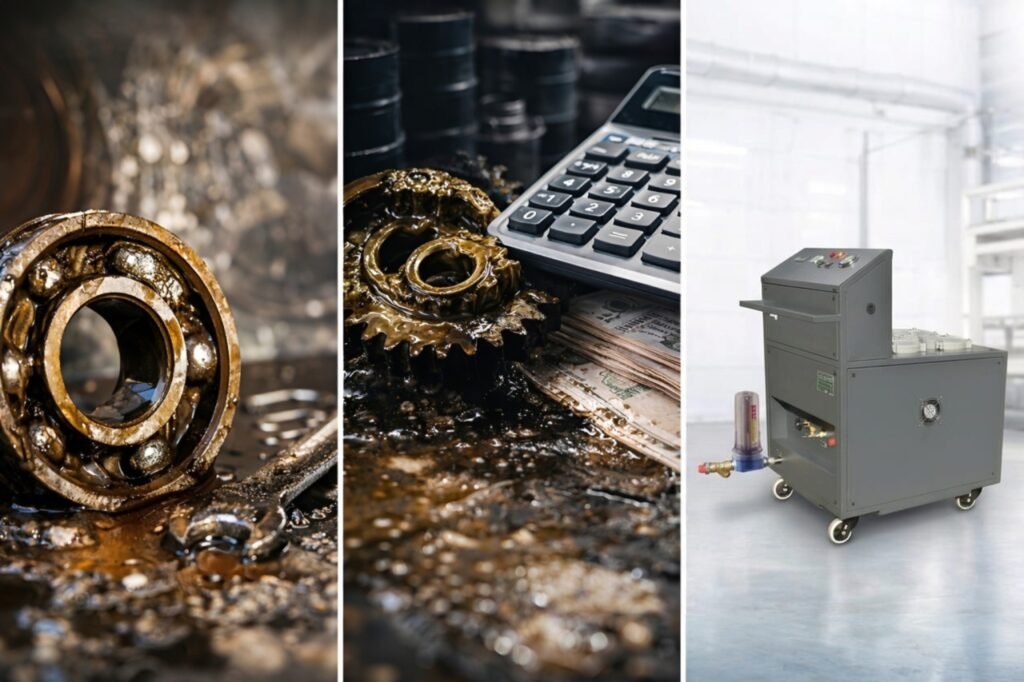
Think of your hydraulic and lubrication systems like the bloodstream of your plant. Would you ignore contamination in blood? Probably not. Yet, oil contamination—dust, moisture, sludge, metal particles—often goes unnoticed until it turns into a breakdown.
The real question isn’t if dirty oil is costing you. The real question is: how much is it costing you every year?
Let’s break it down with real-world calculations that reflect what actually happens inside plants.
Where Does the Loss Actually Come From?
Dirty oil doesn’t just create one problem—it creates a chain reaction. Each issue compounds the next, leading to massive hidden costs that rarely show up in one place.
Here’s what typically happens:
Individually, these might seem manageable. Together, they quietly become a financial burden that most plants underestimate.
Real Calculation #1: Downtime Loss
Let’s take a simple example.
Monthly loss = ₹1,50,000 × 2 = ₹3,00,000
Annual loss = ₹3,00,000 × 12 = ₹36,00,000
That’s ₹36 lakhs lost—not because of a major accident, but because of recurring issues caused by dirty oil.
Now ask yourself: how many times does your plant experience “minor” stoppages?
Real Calculation #2: Component Replacement Cost
Contaminated oil accelerates wear in critical components like servo valves, pumps, and bearings.
Let’s assume:
Normal condition (2 years):
→ ₹1,20,000 every 24 months
With dirty oil:
→ ₹1,20,000 every 6 months = ₹2,40,000/year
Extra annual cost = ₹1,80,000 per valve
Now multiply that across multiple machines. The numbers escalate fast.
Real Calculation #3: Oil Replacement Cost
Dirty oil doesn’t last. Instead of using oil for its full lifecycle, plants often replace it prematurely.
Example:
Cost per change:
→ 500 × ₹250 = ₹1,25,000
Annual cost with contamination:
→ ₹1,25,000 × 2 = ₹2,50,000
Extra annual cost = ₹1,25,000 (just for one machine)
And this doesn’t even include disposal costs or labor.
Real Calculation #4: Energy Loss Due to Inefficiency
Dirty oil increases friction and reduces system efficiency. Pumps work harder, motors draw more power, and energy bills climb quietly.
Let’s assume:
Daily extra consumption:
→ 5 × 20 = 100 kWh
Monthly (30 days):
→ 100 × 30 = 3000 kWh
At ₹8 per unit:
→ ₹24,000/month
→ ₹2,88,000/year
That’s nearly ₹3 lakhs lost just in electricity—without any visible red flag.
Putting It All Together: The Real Annual Loss
Let’s combine these conservative estimates:
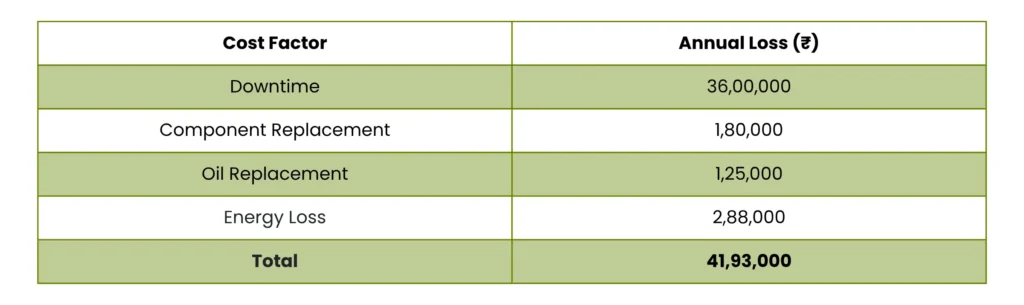
That’s over ₹40 lakhs per year—from just one section of a plant.
Now imagine scaling this across multiple lines or machines. The number easily crosses crores.
Why Most Plants Don’t Notice This
Here’s the tricky part: these costs are never presented together.
No single department sees the full picture. That’s why dirty oil remains an invisible cost centre.
The Real Pain: It Only Gets Worse Over Time
Contamination isn’t static—it grows.
It’s like ignoring a small leak that eventually floods the entire system.
And the worst part? By the time you notice, the damage is already expensive.
So What’s the Way Out?
The smartest plants don’t wait for breakdowns—they prevent them.
Maintaining oil cleanliness through proper oil filtration practices ensures:
Using a reliable oil filtration machine allows continuous removal of contaminants like moisture and particles, keeping oil in optimal condition without frequent replacement.
But more importantly, it gives you control. Instead of reacting to failures, you start preventing them.
The Bigger Question You Should Be Asking
Instead of asking, “Do we need better oil maintenance?”, the real question is:
“How much more are we willing to lose before we act?”
Because, as the calculations show, the cost of doing nothing is far greater than the cost of fixing the problem.
Conclusion
Dirty oil isn’t just a maintenance issue—it’s a financial leak that quietly impacts productivity, efficiency, and profitability. The numbers don’t lie. Even with conservative estimates, plants can lose tens of lakhs annually due to contamination-related issues.
When you start looking at oil not as a consumable but as a critical asset, everything changes. Decisions become proactive, costs come under control, and machines perform the way they’re meant to.
The difference between a struggling plant and a high-performing one often comes down to the details others ignore. And oil cleanliness is one of the biggest ones.


